A Hurghada to Luxor day trip is one of the most rewarding days you can take from the Red Sea coast, and yes, it is worth the early alarm. The drive is roughly 3.5 to 4 hours each way across open desert, so you leave around 5am and return after dark: a long day, but a very doable one. In a single trip you can stand inside the painted tombs of the Valley of the Kings, walk the terraces of Hatshepsut's temple and the forest of columns at Karnak. Our advice, after doing this run more times than we can count, is simple: go private, not by big coach, so the day bends around you rather than a group of forty.
Is the Hurghada to Luxor day trip worth it?
Here is the honest answer: if you have any interest in ancient Egypt, this is the single most rewarding day you can take from the coast, and it outclasses another day on a lounger. Luxor sits on the site of Thebes, the capital of Egypt at the height of its power, and it holds the densest concentration of monuments anywhere on earth. In a few hours you move from royal tombs cut deep into a desert valley to temples so large that a medieval village once lived inside their walls. The catch is distance and heat, which is why how you do the trip matters as much as whether you do it.
At a glance, here is what a day trip from Hurghada to Luxor puts within reach:
- The Valley of the Kings, with the painted burial chambers of the pharaohs, and Tutankhamun's tomb on a separate ticket.
- The Temple of Hatshepsut, rising in three terraces against the cliffs of Deir el-Bahari.
- The Colossi of Memnon, two seated giants that once guarded a temple now vanished.
- Karnak, the largest religious complex of the ancient world, and its hall of 134 towering columns.
- Luxor Temple, in the heart of town, best seen lit against the dark of the late afternoon.
- The optional sunrise hot-air balloon over the West Bank, if you decide to stay the night.
You will not linger over every one of these in a single day, and you should not try to. Two or three sites given proper time beat six seen at a jog. We plan the run around the light and the heat, and around what you most want to stand in front of.
How long is the drive from Hurghada to Luxor?
By road, Luxor is roughly 280 to 300 kilometres from Hurghada, and the drive takes about 3.5 to 4 hours in each direction depending on how quickly you clear town and how many stops you make. The route runs inland across the open Eastern Desert, flat and empty for long stretches, before dropping into the green ribbon of the Nile valley. The road is sealed and in good condition, and the old rule that tourist vehicles had to travel together in a police convoy was abandoned years ago. That single change is what makes a flexible, early departure possible.
A day trip from Hurghada to Luxor almost always begins around 5am. The early start is not there to punish you: it buys you the coolest, clearest hours at the Valley of the Kings before the sun and the crowds arrive, and it gets you home at a civilised hour. A good private car has proper air conditioning and pauses once for coffee and a restroom about halfway. If the long desert drive is on your mind, our guide to whether Hurghada is safe covers the roads and the region; in short, the route is well travelled and routine.
If anyone in your party gets car sick, ask for a front seat and bring something for it. The desert road is smooth but long, and the return leg, after a full day on your feet, is when it tends to bite.
The West Bank: Valley of the Kings, Hatshepsut and the Colossi
Luxor divides neatly in two. The West Bank, where the sun sets, was the land of the dead: the burial valleys and the mortuary temples of the pharaohs. Most day trips start here, on the far side of the Nile, and work back toward town while the morning is still cool.
The Valley of the Kings
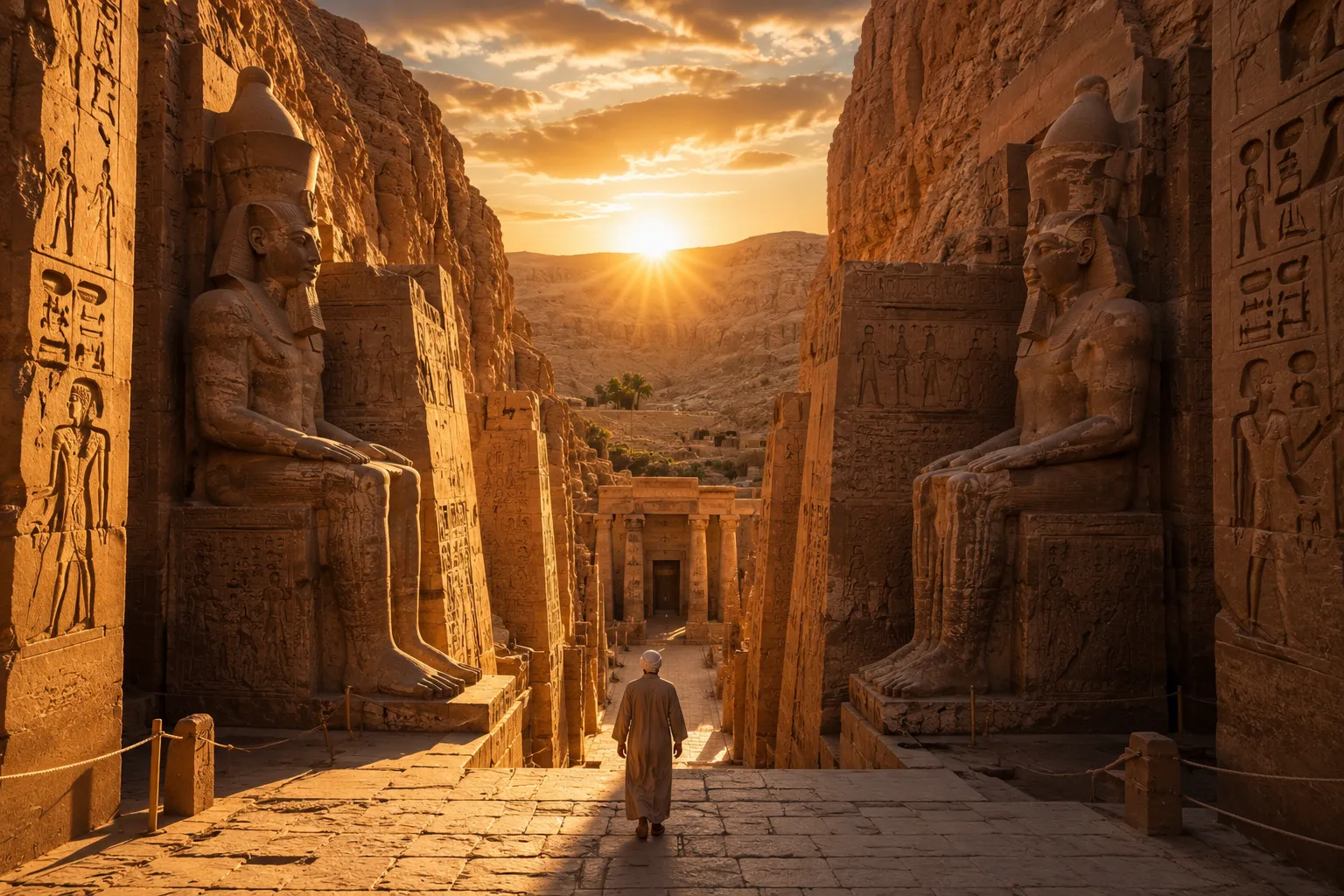
In a dry valley behind the cliffs, more than sixty tombs were cut for the kings of the New Kingdom, hidden away after centuries of pyramids had proved too easy to rob. A standard ticket lets you into three tombs of your choosing, and the guardians will steer you toward whichever are open and quietest that morning; the great tombs of Ramesses III and Ramesses IX are often among the best of the everyday choices. What surprises everyone is the colour: corridors and burial chambers carpeted floor to ceiling in hieroglyphs and painted scenes, many still vivid after three thousand years. Not every tomb is open at once, so which three you see depends on the day, which is part of why a guide who knows the valley earns their keep.
You descend a ramp cut three thousand years ago, the air cools, and the ceiling above you is still deep blue and scattered with painted stars. No photograph gets the colour right.Field notes · The Solara Journal
Tutankhamun's tomb needs a separate ticket, as do a couple of the finest tombs such as Seti I. The famous boy-king's chamber is small and plain compared with the great royal tombs, but his mummy still lies inside it. Buy the extra tickets at the visitor centre before you walk in.
The Temple of Hatshepsut
A short drive away, the mortuary temple of Hatshepsut rises out of the desert floor in three broad terraces set hard against a wall of golden cliffs at Deir el-Bahari. It is one of the most architecturally modern-looking buildings of the ancient world, and it was raised for one of Egypt's rare female pharaohs. The ramps and colonnades are exposed and there is little shade, which is exactly why you want to be here in the morning rather than at noon.
The Colossi of Memnon
On the road back toward the river stand the Colossi of Memnon: two seated stone giants, each around eighteen metres tall, weathered almost featureless by time. They once flanked the entrance to a mortuary temple that has otherwise disappeared. This is a quick stop, ten minutes for photographs, but the scale of the two figures against the fields makes the point about how much larger everything here used to be.
The East Bank: Karnak and Luxor Temple
Cross back to the East Bank, where the sun rises, and you move from the land of the dead to the land of the living: the great temples of Amun that were the beating heart of ancient Thebes. These are the afternoon of the day, and they are where most people run out of superlatives.
Karnak Temple
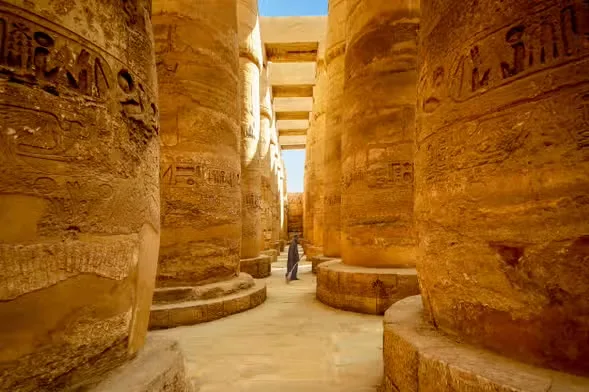
Karnak is not a single temple but a vast complex built and rebuilt over some two thousand years by pharaoh after pharaoh, each adding a hall, a pylon or an obelisk. Its centrepiece is the Great Hypostyle Hall, a forest of 134 sandstone columns so massive that a dozen people could stand on the capital of a single one. Walking into it is the moment most visitors go quiet. Give Karnak more time than you think you need.
Luxor Temple
In the middle of town, a short way south, Luxor Temple was linked to Karnak by a two-mile avenue of sphinxes, recently cleared and reopened as the Avenue of Sphinxes. Smaller and more human in scale than Karnak, it is best seen in the late afternoon and into the evening, when the low sun warms the stone and the floodlights come up. If your day allows only a glimpse here, take it at dusk.
Should you add the sunrise hot-air balloon?
The dawn hot-air balloon over the West Bank is the one add-on people never regret. You lift off before sunrise and drift for around forty-five minutes over the Valley of the Kings, the temples and the green fields as the light turns the whole valley gold. Prices vary with the season and the operator, but expect roughly 80 to 150 US dollars per person. The one condition is timing: the balloons launch in the dark, hours before a car from the coast could ever reach Luxor.
Only book the sunrise balloon if you are staying overnight in Luxor. It cannot be paired with a same-day drive from Hurghada, because you would need to leave the coast at midnight to make the launch. If the balloon is a must, plan an overnight and do it properly.
Private car, group coach, flying or the train?
Private car is how we do it and how we would want to travel ourselves. One vehicle, your own timing, a guide who answers your questions and a driver who knows the road: door to door from your hotel and back, with the day shaped around you rather than around a manifest of forty strangers.
A large group coach is the budget option and it works, but the trade-offs are real. Departures are earlier, the day is longer, there are more stops for more people, and you move at the pace of the slowest of the group. If the price gap is what decides it, take the coach and go; you will still see Luxor. If comfort and time on site matter more, go private.
Flying looks tempting on a map and rarely helps. Direct flights between Hurghada and Luxor are infrequent and often routed through Cairo, so once you add airport time at both ends you save little or nothing for a single day, at much greater cost. Flying earns its place for reaching Cairo and the Pyramids, which is why we send guests there by plane rather than by road. For Luxor, the car wins.
The train is a common question with a simple answer: there is no direct passenger line from the Red Sea coast. Egypt's railway runs up the Nile valley through Luxor, not across the desert from Hurghada, so using it would mean a bus to the river first and an overnight either side. The sleeper train is a lovely way to travel between Cairo, Luxor and Aswan if you are already on the Nile. It is not a day trip from the coast.
How much does a Hurghada to Luxor day trip cost?
Prices move with the season, the size of your group and what is included, so treat these as ranges rather than firm quotes. A private day trip from Hurghada to Luxor, with a car, driver and guide, typically runs somewhere from roughly 80 to 200 US dollars per person, falling as your group grows, since the cost of the car and guide is shared. A seat on a large group coach is cheaper, often in the region of 40 to 70 dollars, which is its main appeal.
Site entry tickets are usually separate and paid on the day, and Egypt raises them periodically, so budget a little extra rather than assuming last year's figure. The Valley of the Kings general ticket, Karnak, the Temple of Hatshepsut and Luxor Temple each carry their own admission, and the premium tombs, Tutankhamun among them, cost more again. Add lunch, the hot-air balloon if you take it, and a float of small notes for tips. Ask exactly what your price includes before you book: the real gap between a bare coach seat and a genuinely private, guided day sits in the tickets, the lunch and the quality of your guide.
A realistic hour-by-hour itinerary
No two days run exactly alike, but this is the rhythm of a well-planned private trip. It front-loads the tombs into the cool morning and keeps lunch out of the worst of the midday sun.
- 5:00am: Coffee and pickup from your Hurghada hotel; settle in for the desert road.
- 8:30 to 9:00am: Arrive on the Luxor West Bank as the day is still fresh.
- 9:00 to 10:30am: The Valley of the Kings, three tombs plus Tutankhamun if you have added the ticket.
- 10:45 to 11:30am: The Temple of Hatshepsut at Deir el-Bahari.
- 11:40am: A ten-minute photo stop at the Colossi of Memnon.
- 12:30 to 1:30pm: Lunch near the river, out of the midday heat.
- 2:00 to 3:15pm: Karnak Temple and the Great Hypostyle Hall on the East Bank.
- 3:30 to 4:15pm: Luxor Temple, then onto the road home.
- 8:00 to 8:30pm: Back in Hurghada in time for a late dinner.
What to bring, and handling the heat and the walking
Luxor is hot and dry, and the numbers are not shy. In high summer the afternoon can pass 40°C, well over 100°F, and even in the mild winter months the midday sun on open stone is strong. This is desert, not coast, so there is no sea breeze to soften it. The most comfortable months for the trip are the cooler seasons, roughly October to April; our guide to the best time to visit Hurghada covers the seasons in full.
Bring more water than you think you need and keep drinking it. Wear light, modest clothing that covers your shoulders and knees, both out of respect and to keep the sun off, and put on real closed shoes rather than sandals: tomb ramps and temple floors are uneven and dusty. Add a hat, sunglasses and strong sun cream, and reapply through the day. You will walk several kilometres, some of it up and down tomb corridors and across wide temple courtyards, so this is a day for people who are steady on their feet.
One practical note that catches first-time visitors out: bring cash, in small notes. Egyptian pounds in small denominations are what you need for the guardians who point out a hidden relief, for restrooms, for tips at lunch, and for your driver and guide at the end of a long day. Cards are of little use at the sites themselves, and change is not always easy to come by.
Is one day enough, or should you stay overnight?
One day is enough to see the headline sites, and it is what most visitors do. You will come home tired and full of it. But be honest with yourself about the length: door to door it is a 14 to 16 hour day, most of it either on your feet or in the car.
An overnight in Luxor changes the trip entirely. You can add the sunrise balloon, take the West Bank in the cool of the morning and the East Bank temples in the golden late afternoon, and stand in Karnak or Luxor Temple after dark when they are lit and nearly empty. You also get the Nile itself: a felucca at sunset, dinner by the water, the slow river light that the day-trippers never see.
An overnight also opens up the evenings. Karnak runs a sound-and-light show after dark, walking you through the temple by floodlight as its history is narrated, which is unashamedly theatrical but a fine way to end a day. And with a morning to spare you can slow down over breakfast rather than climbing back into the car at first light, which after fourteen hours on the road the day before is its own kind of luxury.
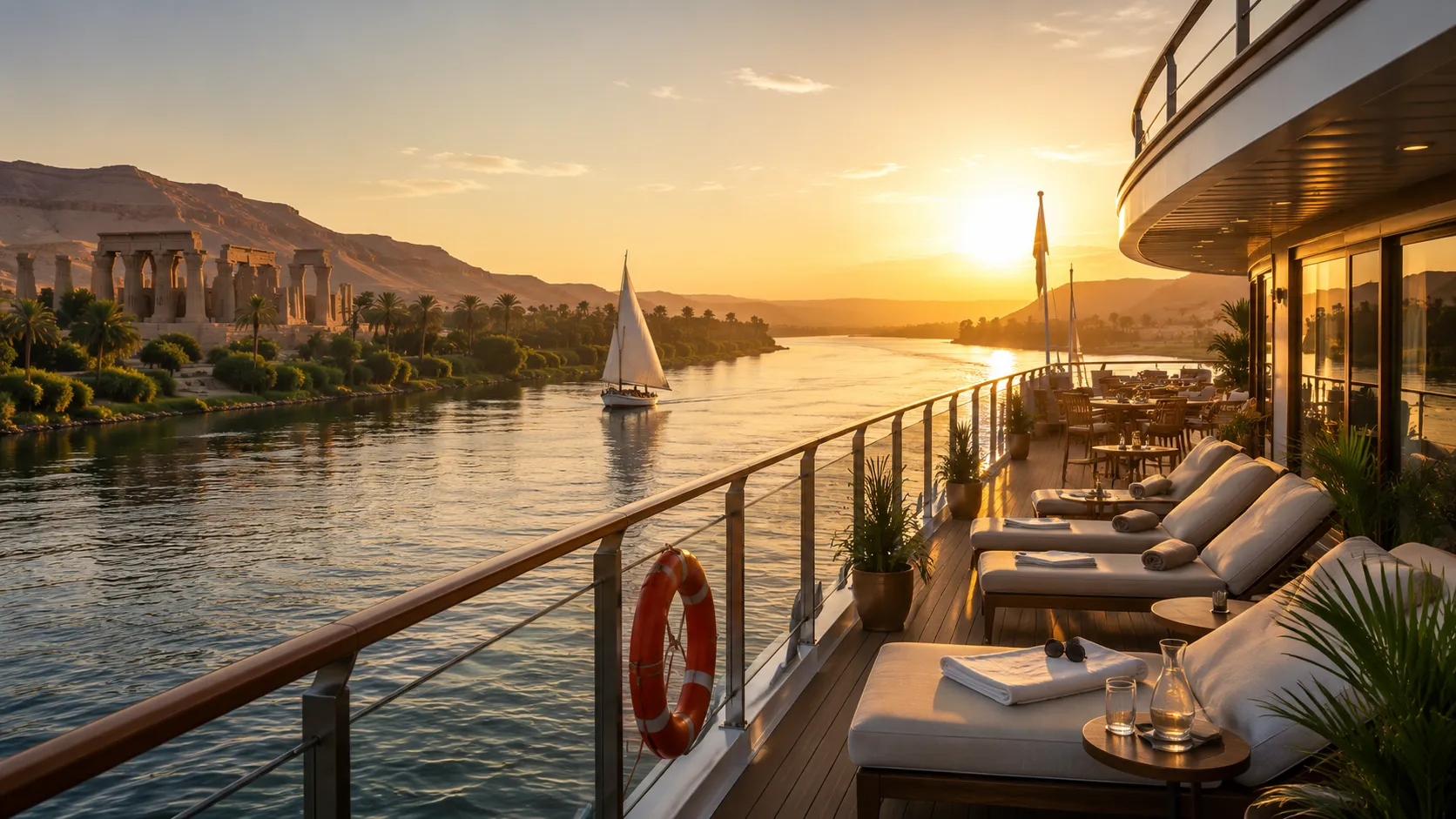
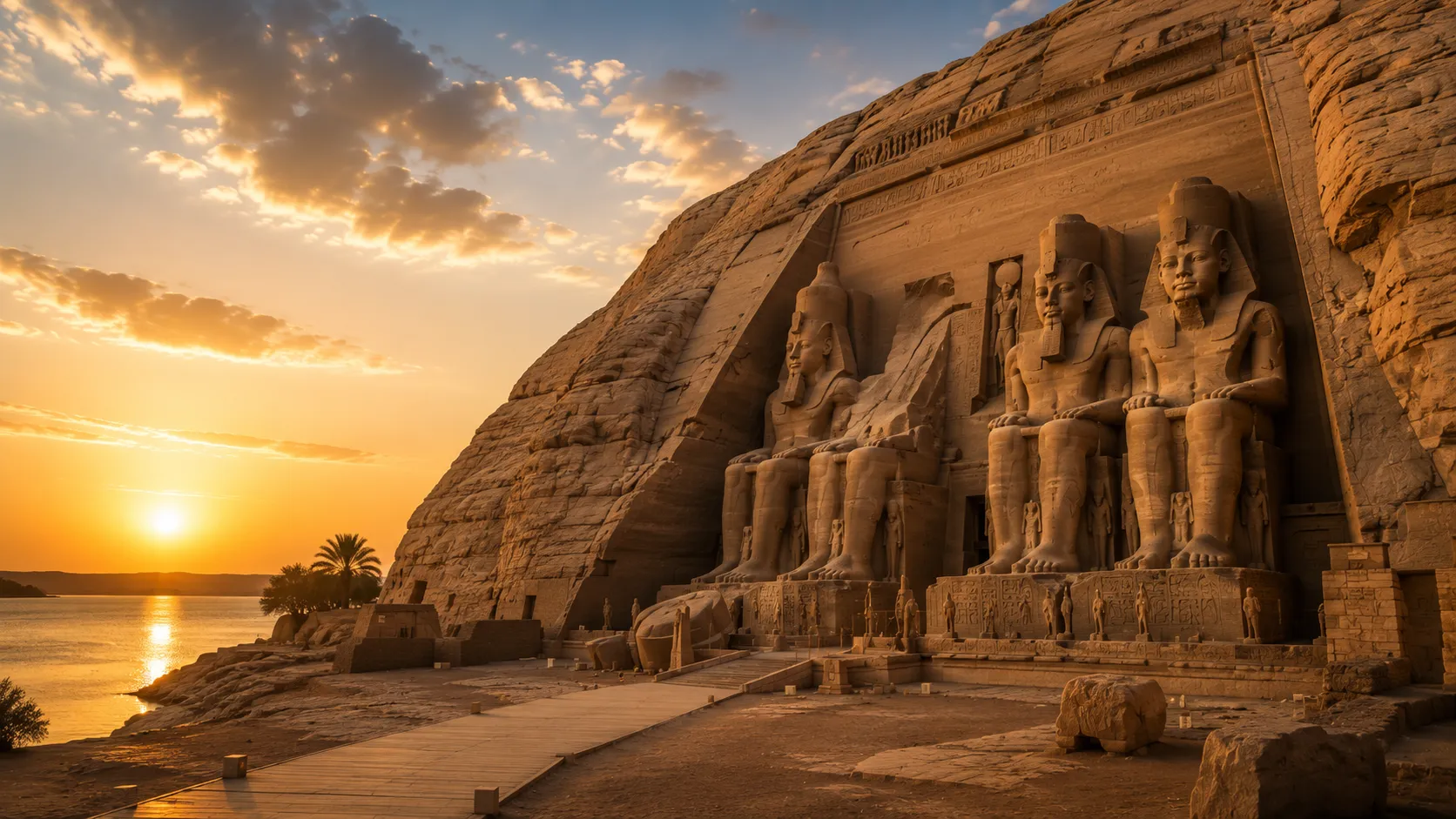
If Luxor lights the fire, you can keep going south. Many of our guests turn the overnight into a Nile cruise between Luxor and Aswan, drifting past temples and villages over several days, or press on to the colossal rock temples of Abu Simbel near the Sudanese border. The Red Sea will still be there when you come back to it.
How to be a respectful visitor at the temples
Luxor's monuments have survived three thousand years, and a little care keeps them standing. Do not touch the painted reliefs or lean on the carvings; the oils from thousands of hands are one of the things slowly erasing them. Photography is allowed in most places, though some tombs require a separate photo ticket and a few forbid it outright, so watch for the signs and ask before you shoot.
The guardians at the tombs and temples are part of the experience. They will show you a detail you would have missed and expect a small tip in return, which is normal and fair; a note or two is plenty, and you are free to decline politely. Keep your voice down inside the tombs, do not climb on the monuments for a photograph, and during Ramadan be gracious if some services slow in the afternoon. None of this is difficult. It is simply the difference between a visitor and a guest.
The mistake is trying to see everything. We would rather you stood quietly in two great temples than rushed through five and remembered none of them.A Solara concierge
Go deeper into ancient Egypt
How Solara plans your Hurghada to Luxor day trip
We run the Luxor day as a private trip because we think it is the only way it really makes sense. A comfortable car with a driver who knows the desert road, a licensed Egyptologist guide who brings the tombs and temples to life, tickets and timings handled in advance, and a pace set by you rather than by a coach full of strangers. We time the Valley of the Kings for the cool early hours, keep lunch out of the midday sun, and get you home to Hurghada in good order.
If you are still shaping your holiday, our complete Hurghada travel guide ties the whole trip together, and our roundup of the best things to do in Hurghada covers the sea and desert days that pair well with a day inland. You can browse every guide in the Solara Journal, or simply tell us what you most want to stand in front of and we will build the day around it. However you travel to Luxor, go: for many people, it is the reason they came to Egypt in the first place.